


Authors

Working Paper 215 (WP215) provides a detailed summary of how mortality and critical illness claims experience is developing across the UK term protection market. Drawing on claims experience from 2022-2024, the report covers 3 distinct benefit types: mortality (including terminal illness), accelerated critical illness and standalone critical illness, and examines both standard and rated lives business.
This analysis marks a return to analysing experience for groups of calendar years, having focused on single years during and after the COVID-19 pandemic. This removes some of the volatility associated with year-on-year results and gives more credibility to the observations.
The results of WP215 are consistent with recent assurances working papers in that standard lives experience is broadly in line with the existing '16' Series tables and rated business continues to show markedly light experience compared to expectations. The grouped 2022-24 experience does allow more detailed analysis which suggests there are some elements of the tables, for example by attained age and duration, that could be improved.
This blog picks out only a few interesting features of WP215. The paper itself contains a wide-ranging analysis of assurance business over the 2022-24 period examining experience by traditional risk factors such as age, duration, smoker status and sum assured amount as well as broader factors including socioeconomic class, geographical region and cause of death.
Experience by calendar year
The graphs below show the A/E by calendar year for standard and rated lives. Mortality only business is shown on the left and accelerated critical illness is shown on the right. This highlights the different patterns by calendar year for the 2 products with mortality for standard lives reduced from the peak of the pandemic period in 2020/21, although perhaps still above the pre-2020 trend, whilst accelerated CI has seen a material increase over the 2022-24 period following the dip in experience in 2020/21.
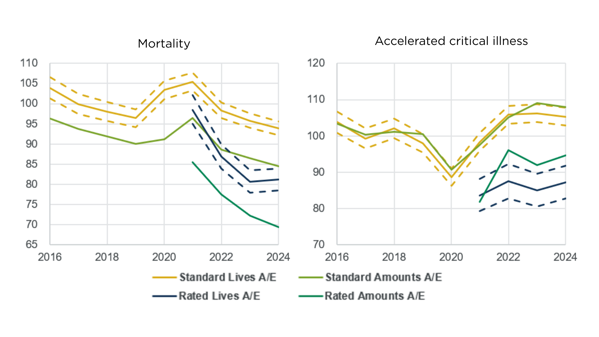
Experience of standalone critical illness is also shown in the report which indicates materially higher morbidity in 2022-24 when compared to 2016-20. However, care should be taken when interpreting this result due to changes in the composition of the offices contributing to the dataset.
Rated experience
The committee has only recently began to analyse rated experience with the first report being Working Paper 207 (WP207) in November 2025. As such data is only available from 2021 but, as indicated above, it shows materially lighter than expected experience when allowing for the ratings applied to each individual policy. WP207 and WP215 discuss potential reasons as to why the experience may be emerging in this manner and the committee will continue to monitor this.
Experience by age and duration
A key requirement of a standard table is not so much the level of the basis, which can be easily adjusted for, but whether the table shape matches the experience by age and duration. One of the objectives of WP215, by grouping years 2022-24, is to test the appropriateness of the table by these risk factors and there are indications that the “16” Series tables are starting to not match emerging experience:
Mortality business
For mortality, male non-smokers experience is lighter than expected in the 55 to 69 age range whilst both male and female non-smokers look to be heavier at the older ages. Patterns are less discernible for smokers due to the lower amounts of claim data.
Early duration mortality experience appears to be lighter than the current allowance in the T16 tables. There are indications that duration 10+ experience is heavier than durations 5-9 but care needs to be taken to allow for potential changes in mix of business at the longer durations.
Accelerated CI
For accelerated business the most notable feature remains the persistently heavy experience among female non-smokers aged 50-54, shown in the left-hand chart below. This pattern has been observed in previous analyses and is thought to be linked to breast cancer screening. An allowance was made for this in the “16” Series tables, using a combined data and judgement-driven approach to inflate incidence rates at ages 47-51, where crude claims rates appear elevated (shown in the right-hand chart below). However it would seem a further adjustment is required in this age group as well as at older ages. Male non-smokers also exhibit an increasing gradient of experience with age which contributes to the overall increased A/E in the 2022-24 period.
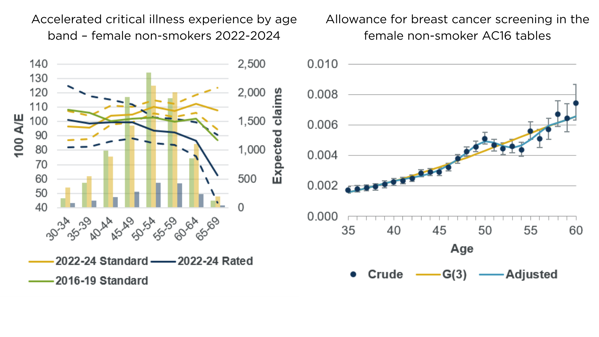
Experience in 2022-24 by duration for accelerated CI business is volatile due to low claim numbers at the early durations however there are indications that the higher experience is being driven by durations 2+, especially for females.
What does this mean for future tables?
At an aggregate level, the existing "16" Series tables continue to provide a broadly reasonable representation of experience. However, the detail beneath the headline results highlights several areas where experience is evolving, which warrants further examination.
It is important to note that the analysis has focused on one-way analyses of experience, whereas a multivariate analysis could shine more light on the interactions between the various risk factors and the interpretation of the one-way results.
The results of WP215 provide an indication that a new graduation may be required in the near future. In preparation for this the committee is currently undertaking a broader review of methodology used to develop the next generation of term assurance tables. The work includes consideration of graduation approaches, multivariate analysis techniques and the overall framework used to assess experience. Additionally there will also be a separate analysis by cause of death for mortality business with the aim of providing further insight into the emerging all-cause experience.