

 Highlights of the CMI Annuities Committee’s first standalone analysis comparing data and experience of the Bulk annuity and SAPS datasets.
The CMI has a target for closer collaboration between the Annuities Committee (which collects data for bulk annuitants from UK insurance companies) and the SAPS Committee (which collects data for self-administered pension scheme members), reflecting the increasing transfer of defined benefit pensions from pension schemes to bulk annuity insurers. The publication of CMI Working Paper 210, which compares data, published mortality tables and mortality experience for bulk annuities and private sector pension schemes in 2016-2023, marks the first step in our closer relationship.
Our first task was to compare the data CMI collects for bulk annuities and SAPS pensioners. If we simply look at the entire Bulk annuity and SAPS datasets, it seems we are comparing apples with oranges. Some of the key differences are:
After these dataset adjustments, at overall level we observe little difference between the mortality experience of the Bulk annuity and SAPS datasets, particularly on a lives-weighted basis. We dig further into the factors we have available for analysis to see what is hidden under the surface.
The SAPS Committee produce a wide range of tables based on the SAPS dataset, including tables differentiated by pension amount band. A new addition for the “S4” Series of tables was the use of Index of Multiple Deprivation (IMD) deciles alongside pension amount bands to graduate new “IMD tables”. Such granular tables are not available for bulk annuities, so we wanted to see how well these differentiated SAPS IMD tables reflect experience of the Bulk annuity dataset.
We compared bulk annuity amounts-weighted experience relative to the projected “S4” Series IMD tables with experience relative to undifferentiated “S4” Series tables. As seen in the charts, experience relative to undifferentiated tables (the gold lines) shows a steep gradient, i.e. mortality gets lighter as IMD group increases. Whereas experience relative to the IMD tables (the blue lines):
Chart: 100A/Es by IMD Group for the Bulk annuity dataset – Males (Left) and Females (Right)
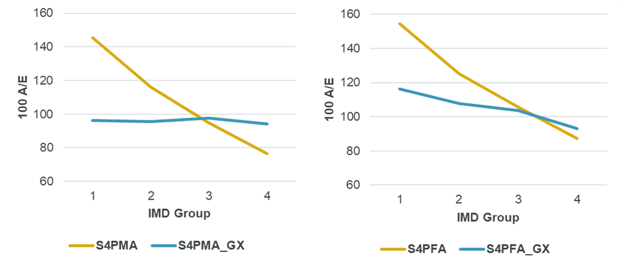
We also considered experience of the SAPS dataset relative to the “S4” Series IMD tables and observed similar conclusions. This suggests that when we allow for differences in pension amount and socio-economic status, the underlying experience of the Bulk annuity and SAPS datasets are similar, which should be comforting for anyone using assumptions based on SAPS tables as part of bulk annuity transactions.
At overall level, it seems experience of Bulk annuities and SAPS are similar, but the age profile and experience by age do show some differences. These were interesting to observe, and readers may want to consider further.
We note that the Bulk annuity dataset is more mature than the SAPS dataset, with a higher average age measured both by exposure and (to a lesser extent) deaths. This is seen in very low data volumes at younger pensioner ages for the Bulk annuity dataset.
For age bands with reasonable data volumes (broadly 75+), we see similar experience for the Bulk annuity and SAPS datasets on a lives-weighted basis, both for males and females. At younger ages, experience is typically heavier for the Bulk annuity dataset than the SAPS dataset. The data doesn’t allow us to say for sure why this is the case, but we speculate that it may be due to the mix of pensioners and dependants; historical bulk annuity transactions were weighted more towards pensioner only deals potentially leading to a higher proportion of dependants at younger ages in the bulk annuity dataset than the SAPS dataset as these deals have aged.
This analysis has been a really illuminating starting point for us and will aid our understanding of experience going forward. We intend to carry out further analysis of bulk annuities and SAPS data in future. If you have any feedback on the paper or suggestions for areas we could consider in future, please contact annuities@cmilimited.co.uk.


